Expanding use of complex patient information management systems and communication technology in healthcare organizations requires nurses to possess core competencies that until recently were not considered as integral to practice as those of a strictly clinical nature. Organizational changes necessary to formally integrate informatics competencies into nursing practice require strong partnerships among facility nursing leaders, educators, and informaticists. The authors describe a strategic initiative one acute care organization used to develop nursing practice that ensures use of system tools to manage patient information, support clinical decision making, optimize workflow, and communicate with members of the care team. The initiative involved defining nursing computer and informatics management skills for the clinical system applications and technologies utilized in the organization and integrating the introduction, evaluation, and on going professional development of the defined informatics competencies into organizational processes and tools to support the bedside nurse.
Reference:
https://journals.lww.com/cinjournal/Abstract/2011/03000/Defining_and_Integrating_Informatics_Competencies.7.aspx
Sunday, 1 July 2018

Dreyfus Model

They created a five-stage model which aims to describe the journey of a person from obtaining a skill to mastering it.
1. Being a Novice
When the individual has little or no experience at all in executing a particular skill. The Dreyfus brothers describe it in a manner, which is untraditional. By “experience” they mean the fact that performing the particular skill would lead to no change of perspective or thought within the person. There are plenty of cases to be given as an example, as many people work in the same position for years, but do not obtain any knowledge, nor “experience” and their ten years of experience on paper, could be taken as a one-year experience when observed through the Dreyfus Model.
The notice aims to succeed and focuses on results rather than knowledge. The latter explains why managing teams consisting of novices could be a struggle.
2. Advanced Beginners
The novice evolves by figuring out the mistakes in his work. The newly, “promoted” advanced beginner dwells into the world of troubleshooting. Unfortunately, the hasty mindset is not lost, and the individual still aims to acquire results fast, in this case gain knowledge and information. An example would be when a coder with years of experience starts learning a new program language, he could be a master in PHP but an advanced beginner in Python. Scrolling through the documentation will not lead to productive results.
3. Competent
We are in the middle ground of the model. An individual falls into this category when he is fully capable of troubleshooting and solving problems on their own, as well as planning their future actions while avoiding previous mistakes. The practitioner will still experience trouble when it comes to pinpointing the exact details to focus on. The IT sphere works mainly in teams in order to smoothen out these processes.
4. Proficient
The individual now looks at the bigger picture. Their focus falls onto understanding the essentials of the framework and often experience frustration when documentation is oversimplified. Proficiency is defined by the self-improvement skills which each person in the stage has. Not only does the proficient practitioner learn from his own mistakes, he observes others as well, anything could be a vital source of information.
5. Expert
The fifth and final stage of the model is when the individual becomes an expert in the field. The difference between the fourth and the fifth stage is that people in the fifth are a source of information and knowledge themselves. Their experience is so vast that other people look up to them. A major part of the work done by the expert is based on his intuition. They lead major teams, write books, conduct studies and etc.
During the seventies, the Dreyfus brothers conducted a thorough research on the topic of how an individual obtains and masters a skill. They observed people with high-quality expertise in different spheres and came to the conclusion, that the individual doesn’t only acquire more knowledge in his field, his whole perception and approach to the world evolves.
Reference:
https://www.360pmo.com/the-five-dreyfus-model-stages/
Turley, 1996

The core components of informatics are:
- Cognitive science
- Information science
- Coomoputer science
Nursing informatics is the intersection between the discipline-specific sciennce and the area of informatics.
Reference:
https://www.slideshare.net/minettedin/theories-models-frameworks
Schwirian, 1986
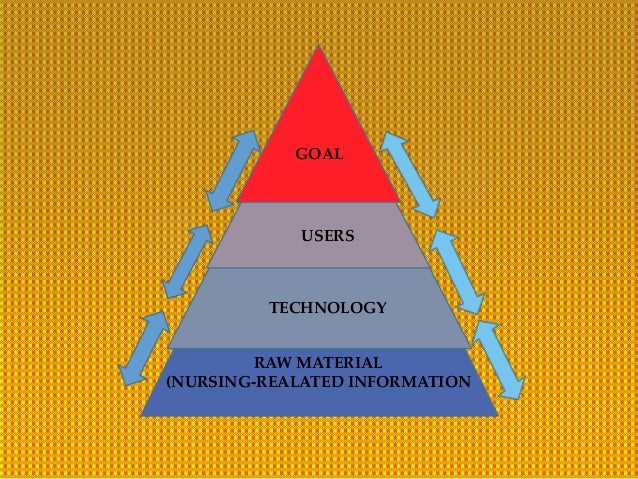
Patricia Schwirian proposed a model intended to stimulate and guide systematic research in nursing informatics in 1986. The model enables identification of significat information needs, that can foster research and somewhat similar to Maslow's hierarchy of needs.
Reference:
https://www.slideshare.net/minettedin/theories-models-frameworks
Graves and Corcoran, 1989
Graves and Corcoran provided the first widely cited definition downplaying the role of technology and incorporating a more conceptually oriented viewpoint: A combination of computer science, information science, and nursing science designed to assist in the management and processing of nursing data, information, and knowledge to support the practice of nursing and the delivery of nursing care.
They discussed the need to understand “how clinical nurses structure clinical problems and how they ask questions of the information system.” These views drew researchers involved in the study of decision making under the rubric of nursing informatics. Graves and Corcoran's definition allowed a concentration on the purpose of technology rather than on the technology itself. Their transformation of the definition for nursing informatics changed the focus from technology to information concepts by expressly incorporating information science.
Reference:
https://www.ncbi.nlm.nih.gov/pmc/articles/PMC344585/
Healthcare Informatics Model
The health informatics model consists of three essential parts: data, information and knowledge. These elements are arranged in a hierarchy, with data at the base of the model providing the basis for establishing information and leading in turn to the potential generation of knowledge. The informatics model converges closely with the principles, aims and tasks of evidence-based medicine (EBM), particularly as they relate to searching, appraising, reviewing and utilizing information and research. The development of health informatics today has its origins in the growth of statistics in the 18th and 19th centuries. As a new and growing discipline, statistics burgeoned amidst the challenge of measuring, monitoring and ultimately governing societies in the throes of massive change and expansion. The governance role embraced by statistics in the past resembles many aspects of the role ascribed to audit, quality assurance and EBM today. There are some deep-seated paradoxes within the field of health informatics. The informatics model posits an oversimplified and linear progression of data to information and knowledge. Health informatics may involve the spreading and dissemination of information but this should be seen as only a part, not the equivalent, of the complex process of generating knowledge.
Reference:
https://www.ncbi.nlm.nih.gov/pubmed/12180361
Reference:
https://www.ncbi.nlm.nih.gov/pubmed/12180361
Nursing: Standards and Scope of Practice
The scope and standards of practice are authoritative statements on how the professional nurse should practice. They aren’t prescriptive; they don’t state exactly how to perform specific job tasks or functions. But they do serve as a guide on how to perform those tasks and functions competently.
Providing a framework for the expectations of critical thinking and professional behavior, they are developed by nursing specialty organizations in concert with the American Nurses Association (ANA). All documents are approved by ANA and must be based on the cornerstone document ANA’s Nursing: Scope and Standards of Practice (2nd edition). This book sets standards of practice and professional performance for registered nurses (RNs) in all specialties, roles, and practice environments. Nursing specialty organizations then develop documents to meet the practice and performance competencies of their specific specialty. (See Scope and standards: The legal standard of care by clicking the PDF icon above.)
As a nurse administrator, I sought guidance from Nursing Administration: Specialty Scope and Standards of Practice. This book offers conceptual models that nurse administrators should study and understand so they can do their job effectively. The scope statement provides a conceptual description of the specialty—the who, what, when, why, and how. Although it doesn’t cover the clinical scope of practice, it defines the specialty nursing practice and differentiates it from other types of practice.
Reference:
https://www.americannursetoday.com/scope-and-standards-of-practice-documents-guiding-you-to-leadership-success/Nursing's Social Policy Statement
Nursing’s Social Policy Statement is about the many ways that nursing helps others. It is about the relationship—the social contract—between the nursing profession and society and their reciprocal expectations. This arrangement authorizes nurses as professionals to meet the needs involved in the care, and health of patients and clients and the health of society. It helps nurses engage in the political and legislative action that supports nursing education, research, and practice to better influence that health and care; and to understand the social ethics and justice that affect global and individual health.
Reference:
https://www.nursingworld.org/nurses-books/guide-to-nursings-social-policy-statement-understanding-the-profession-fr/
Code of Ethics for Nurses
The Code is an entirely new document produced for nursing ethics in the country, which was published in Farsi (10). It is also available through the website of MOHME (11). The English version is enclosed here as annex1. The target audience includes all nurses in the fields of nursing education, research, administrative, and clinical care, in the whole.
The National Code defines the values which are comprehensive and culturally-adapted. Then, it classify the ethical responsibilities as five main parts of “Nurses and People”, “Nurses and the Profession”, “Nurses and Practice”, “Nurses and Co-workers”, and “Nursing, Education and Research”, including 71 provisions in total.
The code sets out the required elements for ethical conduct and empowers nurses to make ethical decisions more perfectly as they perform as clinical nurses, researchers, administrators and policy-makers. It also reminds the nurses of the valuable state of their profession and what they should attempt to uphold as a nurse in providing direct care to clients/patients, teaching nursing students, performing research, and the supervision and management.
As a main general conceptual background of the National code, the patients are not considered as only people who receive the nursing care, and others including the patients’ family and healthy people in the society are considered in the plans and services. Another essence of the Code is that the individual dignity should be respected, regardless of who is receiving the care, or from which nationality, ethnicity, religion, culture, socio-economic class, gender, etc the patient/client is. Meanwhile, under the provisions of the National Code, nurses must recognize and respect cultural sensitivity in everyday practice, even in this era of globalization.
According the Code, the nurses should be sensitive to the ethical challenges and do their best to fulfill their moral duties. It also emphasizes the importance of informed consent, and addresses main ethical issues in everyday practice such as respect to privacy and confidentiality of patients/clients, relationship with colleagues, efficient performance of the professional duties, conflicts of interests, ethics in educational activities and protection of participants in research.
The Code also deals with the administrative duties of nurses. Moreover, it elucidates the concern of how the nurses should communicate with the hospital ethics committee for decision-making when are confronted with ethical cases.
Subscribe to:
Comments (Atom)